
Hilly drives, long gravel lanes and busy subdivision entrances all put automatic gates to work. When yours drags, groans or won't shut, here is how it gets moving again. The estimate is free.
Tell us what the door is doing. Nothing begins until you've heard the number, and hearing it is free.
If it's metal and moves on its own, we work on it: twin swing leaves on stone columns, a slider across a wide entrance, a single swing gate at the foot of a sloped drive, or a cantilever gate riding on rollers with no track underneath.
Plenty of gates around here sit on acreage outside the city limits, where the drive climbs or drops toward the road. A leaf hung on a slope fights gravity for half of every swing, and it shows in how its hinges and operator wear.
We treat the gate and the machine beside it as one job, since trouble in one always turns up in the other.
When a subdivision entrance or a gate shared by several households sticks, it moves to the front of the line. A whole street is waiting on it.
Business entrances get the same treatment, with one difference: a gate that opens dozens of times a day wears through parts faster, so we size and service it for that traffic.
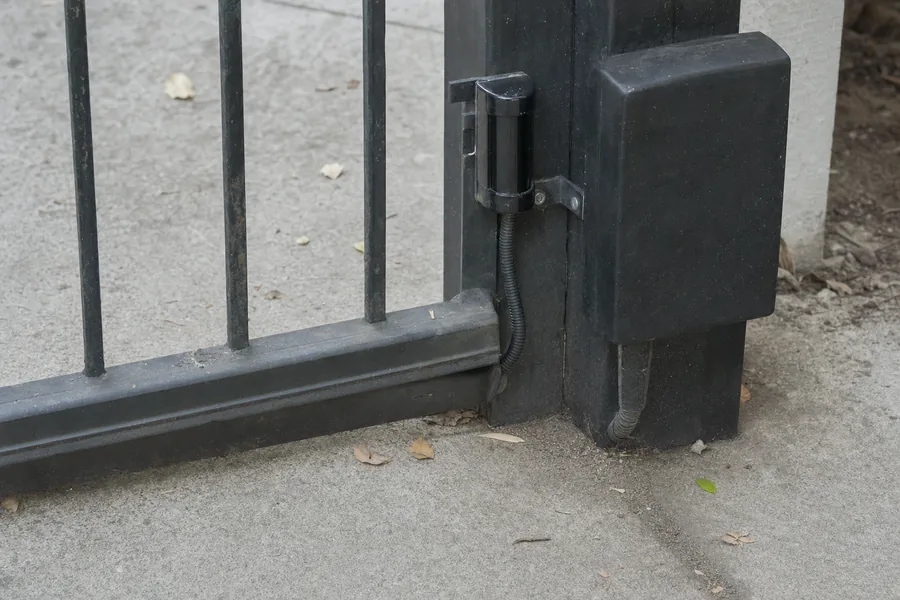
Owners tend to blame the motor, but it's seldom the first thing to go. These are the parts we replace most often.
Muggy summers corrode hinge pins and terminals from the inside out. Ice storms glaze photo eyes and lock latches solid. Spring thunderstorms put surges on the line that can finish off a board in a single night.
Gravel drives add a hazard of their own. Loose rock kicked up by tires collects in slider rails and around swing stops, and a gate that keeps catching on it strains its operator every day.
Then there's gravity and wind. A gate on a slope loads its lower hinge every time it swings, and a solid leaf catches a gust like a sail, which can shove it past its stop or kink the arm.
An operator only pushes so hard before its force limit trips. A binding gate makes it hit that limit again and again, or strain until the gearbox gives. Bolt a new motor onto the same binding gate and you've only restarted the clock.
That's why our visit starts with a wrench, not a meter. We unhook the arm, walk the gate through its swing by hand, and square up hinges, posts and rollers before deciding anything about the operator.
A gate that glides by hand runs for years on a healthy operator. One that fights your hand will chew through operators, new or old.
Much of what makes a gate work isn't the motor at all. It's the remote on your visor, the keypad at the post, the intercom, the phone-entry box and the loop in the drive. Plenty of dead-gate calls end with a control that quit.
We program remotes, change codes, swap tired keypads and receivers, fix intercoms and test loops, usually without a second trip.
Gates shared by several households tend to collect old codes and stray remotes over the years. Clearing the receiver and handing out fresh codes puts access back with the people who should have it.
Same rhythm as a garage door call, with more time spent on the gate itself.
Around town it's mostly LiftMaster, Chamberlain, Mighty Mule, Nice and Apollo, Viking, DoorKing, Linear, Elite, FAAC, GTO and US Automatic, and the common parts for them travel with us.
Snap a photo of the label on your operator and text it over when you call, and the right part is usually aboard when we pull in.
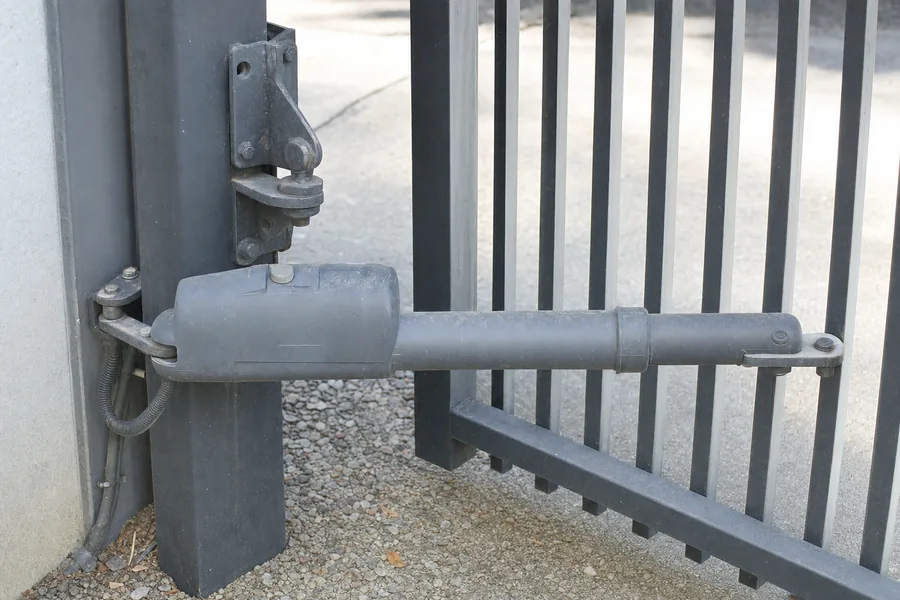
Can your old operator be saved? Most of the time. A battery, a board, a capacitor, an arm or fresh stop points, and it carries on.
Operators fail piece by piece, and pieces can be swapped, so most of our gate calls end with the original operator still bolted to its post.
The exceptions are an operator whose motor has burned out, a model nobody makes parts for anymore, or a gate that has outgrown what the operator was built to move.
When a new unit is the right call, it's sized to the gate you actually have, slope and wind included, and you hear the reasoning before anything is ordered.
Any lights on the operator? A click, a hum or nothing? Did a storm or a power blink come first? Is every control dead, or just one? Keep the cover on; those answers are what we need.
Stuck open? Tell us, and you move up the list. If a part has to be ordered, we close and secure the gate by hand before leaving.
Stuck shut with your truck on the wrong side? Tell us that too. Getting you out comes first.
Some calls do end inside the operator: a board that's gone, a failed capacitor, a worn gearbox or lost stop points. Our gate opener page walks through that visit.
Yes, and cantilever gates too, steel or aluminum, on linear arms, articulated arms, chains or racks.
Usually a safety device raising a false alarm: a smudged or bumped eye, or an edge that has split. We test those before touching anything else.
Usually. Parts for the common makes ride with us, so most gates are back in service before we leave, and if something has to be ordered you'll know the timing on the spot.
We treat it that way. Tell us when you call, and if a part has to come later, the gate gets secured by hand first so the property isn't left open overnight.
Usually. If the motor is healthy and parts are still made, keeping it makes sense, and you'll hear the reasons either way.
Yes, as long as it moves easily by hand and the posts are solid. We check both before recommending anything.
Yes: remotes, keypads, receivers, intercoms and phone entry, usually on the same trip as any repair.
Whether you're in Springfield, Nixa, Ozark, Republic or out toward Willard, one call gets you a couple of hours to be home and a heads-up when we're on the way.
Free estimate.
Name, number and a sentence about your gate is all we need. The visit and the estimate are both free.
Easier to explain by phone? Call (417) 216-7189.
Tell us what the door is doing. Nothing begins until you've heard the number, and hearing it is free.