A trailer swung a little wide, a mower parked against the door, a hailstorm, or a summer of humidity working on the bottom seam: around Springfield and out in the county, garage doors get hurt one section at a time. OnPoint Pro Doors replaces the damaged section when it can be matched, says so plainly when it can't, and the estimate is free.
Tell us what the door is doing. Nothing begins until you've heard the number, and hearing it is free.
Out past the city limits, and in plenty of driveways inside them, the garage holds more than a car. Boat trailers, zero-turn mowers and side-by-sides come and go through the same opening, and a door hit low on one side is one of the most common calls we get. The section that took the hit creases, the hinges next to it bend, and the roller on that side often pops out of its track.
A creased section does more than look bad. A sectional door bends at each hinge as it rolls over the curve at the top of the track, and a crease across a section stiffens it in the wrong place. That is why a dented door can start to shudder, bind or hang crooked weeks after the knock.
The bent track and the stray roller are fixed in the same visit, because a new section hung on a crooked track would be damaged the first time the door runs.
Spring storms bring hail that can pock a thin steel door from top to bottom, and straight-line wind that pushes a wide two-car door hard enough to bow a section. A door covered in shallow dimples is often still sound and works fine; one section bowed inward, or a crease where hail hit hardest, is a different story.
Humidity does the slow damage. Summers here are muggy, and a garage that stays shut for weeks traps that damp air. Rust starts inside the bottom seam, behind the rubber seal, and by the time it bubbles through on the face the steel underneath has thinned. Ice storms finish the job: a bottom section frozen to the driveway and yanked loose by the opener can split along the seam.
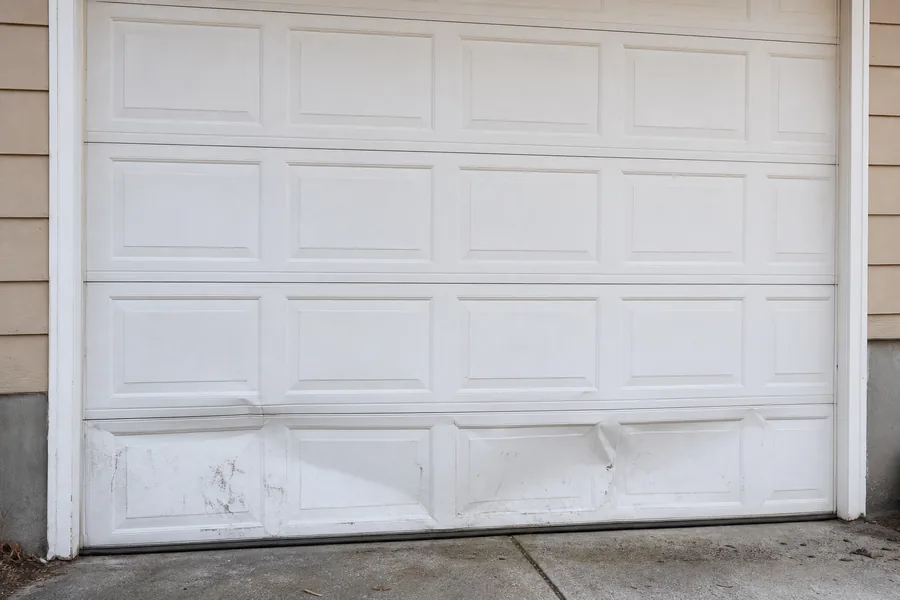
Usually, on a sectional door, yes. The sections are separate pieces joined by hinges, and one can come out while the rest stay. The question that decides it is whether the manufacturer still makes that exact section: the design, the width, the height, the thickness, and whether it is insulated. A lot of steel doors on houses built in the last couple of decades are still supported.
Many brick ranches still have their original doors, and some of those designs went out of production long ago. When no matching section exists, the estimate says so up front and lays out what a new door would involve. Nobody orders a part that doesn't fit and finds out after.
Some doors around here use springs housed inside a metal tube above the door rather than open coils. They are set by a different method, and a section change on one of those doors means the tube springs have to be set again for the new weight. That is technician work with the right tools; the springs hold enough energy to injure someone who tries it by hand.
Open-coil springs get the same attention. Whatever the spring type, the door is balanced after the new section goes in so it rests halfway up without drifting.
A new section comes in the factory color, and a door that has baked in the afternoon sun for years may have faded. You hear about the likely difference before ordering, along with the choices: keep it, paint the door, or treat the dent as the push toward a new door.
Insulated doors get insulated sections, so the door stays stiff, quiet and cooler in July. Window sections are matched the same way, and a cracked insert can often be changed without the whole section.
Metal buildings and shops out in the county often have wide sectional doors that take the same knocks from equipment, only harder. Sections on those doors can be replaced too, and a wide section usually carries a reinforcing strut that goes back on the new one.
When the building houses the work that pays the bills, the door is left closed and secure while the section is on order, and the swap is scheduled around when the shop can spare the opening.
On the older streets near the university, many garages are small detached buildings with a single door, sometimes wood, sometimes a thin early steel door. Matching sections for those are the hardest to find, because the designs are long gone. A sound door with one bad section can sometimes be repaired rather than replaced; a door that is rotted or rusted through in several places usually can't.
Whichever way it goes, a light door on a detached garage is balanced so it lifts easily by hand, with or without an opener.
Measure and order first, then a second visit to install.
Often, yes, if the manufacturer still makes that section for your door. The technician identifies the door and tells you at the estimate.
If it runs crooked, binds or has a roller out of the track, leave it closed and call. A door hit low on one side can drop or jam, and running it with the opener makes the damage worse.
Shallow dimples are mostly cosmetic. A section that is creased or pushed in deeply is weaker and can bind; that is the part worth replacing.
Humid air and water that sits under the seal rust the seam from the inside. By the time it shows on the face, the steel behind it is usually thin.
It will match the design and size. The color can differ slightly on a door that has faded, and you hear that before ordering.
It means the springs are set differently after the new section goes in. The technician handles that; it is not a job for anyone without the tools.
Yes. Wide shop and outbuilding doors get the same section work, with reinforcing struts put back where the door had them.
Yes. You get a free estimate before anything is ordered.
Describe the fault and we'll give you an honest arrival time. The visit and the estimate is free, anywhere in Greene County.
Easier to explain by phone? Call (417) 216-7189.
Tell us what the door is doing. Nothing begins until you've heard the number, and hearing it is free.