Metal shops, ag buildings, storage rows, service bays and small warehouses all lean on their overhead doors, and a stuck one stops the day. We repair sectional doors, rolling steel doors and roll-up sheet doors in town and out in the county, and the estimate is free.
Tell us what the door is doing. Nothing begins until you've heard the number, and hearing it is free.
A shop door that won't open keeps the equipment inside. A storage-row door that won't latch leaves a tenant's things exposed. A bay door that grinds and stalls slows every job that has to roll through it. Business doors also run far more often than house doors, so their springs, cables and rollers wear out sooner and fail at worse moments.
The fix almost always starts with the same question: what does the door do when someone tries to run it? A hum, a stall halfway, a crooked rise, a bang from the shaft. Each of those points toward a particular part, and the technician works backward from there.
For doors that run all day, springs rated for a high number of cycles are the sensible replacement. They're larger and last much longer than the standard springs meant for a house, and the estimate shows both options so the choice is yours.
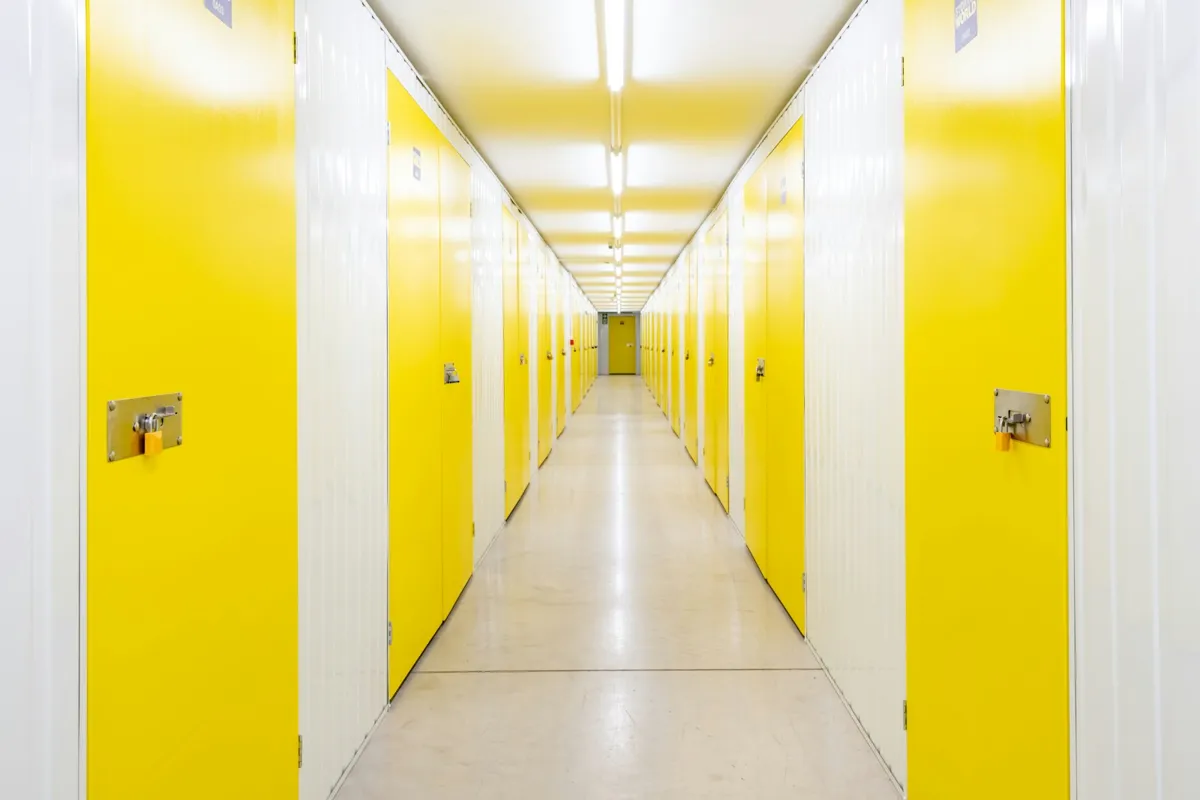
Sectional overhead doors are hinged panels running in tracks, the standard door on shops, service bays and loading areas. Rolling steel doors wind a curtain of interlocking slats onto a barrel over the opening, which suits low headroom and buildings that need to be locked tight. Roll-up sheet doors are the light corrugated kind on storage units, small barns and outbuildings.
On a sectional door the trouble is usually springs, cables, rollers or a damaged panel. On a rolling steel door it's the barrel springs, the slats or the guides the curtain rides in. On a sheet door it's the spring inside the drum or a curtain that has been kinked. Knowing which door you have narrows the visit before it starts.
Out here, plenty of commercial doors share their opening with trailers, tractors, side-by-sides and pickups towing something wide. One clipped corner can bend a track, pop rollers loose and leave a panel creased, and the door will often keep running crooked for a while before it jams or comes off entirely.
In most cases the damaged panel or slats can be replaced by themselves and the track straightened or swapped, which keeps the rest of the door working. The estimate names every damaged part, which helps when the damage has to be accounted for.
Freezing rain glazes the bottom of a commercial door to the slab, and an operator that pulls against that ice can tear the seal, kink the bottom panel or throw a cable off its drum. Humid summers do slower damage: cables and bottom brackets rust where nobody looks, and rollers seize in their stems on doors that sit closed for weeks.
Wide doors on metal buildings also take the brunt of the spring storms. Reinforcing struts across the panels and solidly anchored track help a big door ride out the wind, and a door that has been flexing in gusts is checked for loose hinges and cracked panels. Sealed rollers and galvanized cables hold up far better in that damp.
Commercial operators come in a few types: trolley units hung from the ceiling, jackshaft units that sit beside the door and turn the shaft, and heavier hoist units for rolling steel doors, usually with a hand chain for outages. Most are run from a three-button station and protected by photo eyes and a sensing edge across the bottom of the door.
If the motor runs and the door stays put, the cause is often a slipping clutch, a stretched chain or a worn sprocket rather than the motor itself. A door that reverses for no clear reason usually has an eye knocked out of line or a sensing edge that's split. Either way, the repair is written up and agreed before it's done. Limit settings that have crept, leaving the door short of the floor or overrunning at the top, are reset as part of the same visit.
A door that won't come down at closing time is the call that matters most, because it leaves the building and what's in it open overnight. Say so when you call, and the visit is arranged around getting the door shut and locked first, even if the complete repair needs a part ordered afterward. Mention whether someone has to wait on site, so the plan fits around them.
A door stuck closed on a day when equipment has to roll out is handled the same way: get it open safely, then repair it properly.
Plenty of older shops and barns still lift their doors by a hand chain or by muscle. An operator can usually be added, once the springs are confirmed to be carrying the door's weight, so the motor isn't asked to lift dead weight every morning.
A building with several doors, or a storage row with dozens, can be looked over in one trip. The estimate lists each door by itself, so the worst can be handled now and the rest planned for a slower month.
From one shop door to a full storage row, the order stays the same.
Yes. Roll-up sheet doors, rolling steel doors and sectional overhead doors are all part of the work, including springs, curtains and latches.
Usually not. Damaged panels or slats can often be replaced by themselves and the track repaired, keeping the rest of the door.
Call and say the building can't be secured. The visit is set up around getting the door shut and locked first.
In most cases, yes, once the springs are confirmed to be carrying the door's weight.
Yes. Shops, ag buildings and outbuildings outside town get the same visit as a building on a city street.
Yes. High-cycle springs are offered for busy doors, and the estimate shows them next to standard springs so you can choose.
Yes. Each door is looked over and written up on its own line.
Yes. The door is looked over, you hear what it needs, and the free estimate is yours before any work starts.
Describe the fault and we'll give you an honest arrival time. The visit and the estimate is free, anywhere in Greene County.
Easier to explain by phone? Call (417) 216-7189.
Tell us what the door is doing. Nothing begins until you've heard the number, and hearing it is free.